Spray Foam vs. Traditional Insulation
Fiberglass and cellulose cost less per square foot on paper. Spray foam costs more up front and does more per inch — air sealing, vapor control, and higher R-value in less cavity depth. For new builds, metal buildings, pole barns, and commercial structures, the right call depends on the application, not just the sticker price. Here's the real comparison, scoped to those project types rather than a generic homeowner-attic breakdown.
This page is built for builders, GCs, and outbuilding or commercial property owners deciding what to spec before framing closes up or before a metal shell gets its interior finish — not a residential retrofit comparison. If you're weighing options for an existing home's attic or walls, that's a different project scope than what's covered here.
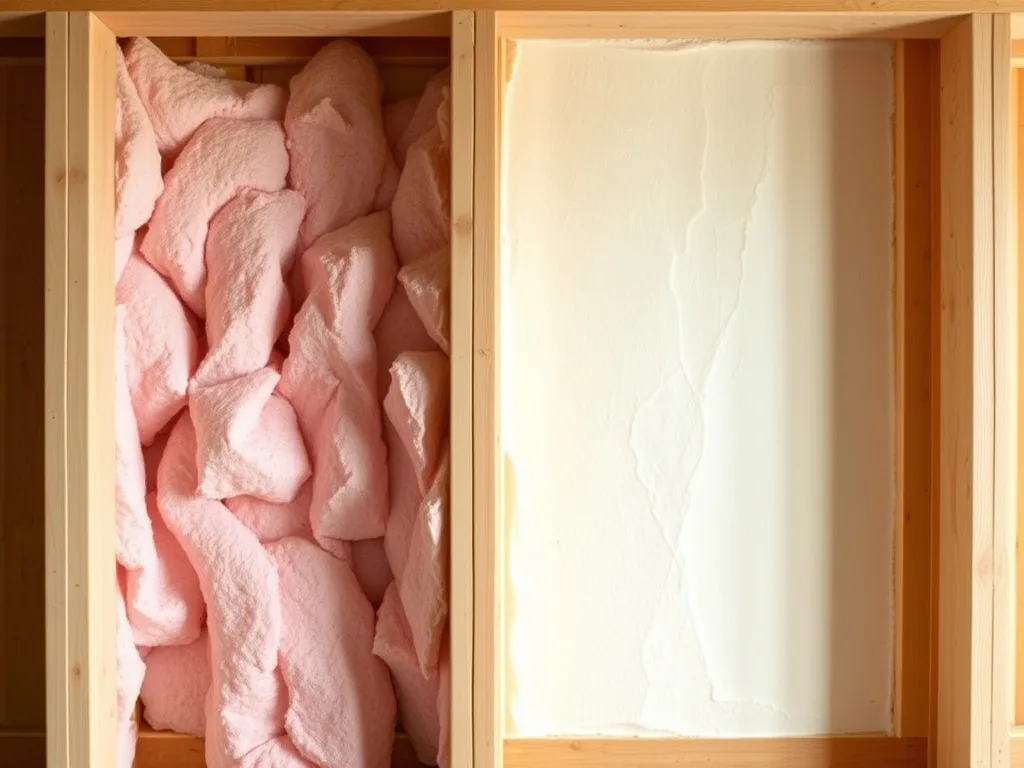
Cost & Performance at a Glance
Installed cost ranges and R-value per inch for every material builders and property owners commonly weigh against spray foam. Cost per square foot tells only part of the story — air sealing and moisture handling matter just as much on a metal building or pole barn, where an unsealed cavity or an unmanaged vapor path causes real problems down the line.
| Material | Installed Cost | R-Value / Inch | Air Sealing | Moisture Handling |
|---|---|---|---|---|
| Open-cell spray foam | $1.00 – $1.75 / sq ft | R-3.6 – R-3.8 / inch | Excellent (self-sealing) | Vapor-open, sound-dampening |
| Closed-cell spray foam | $1.50 – $5.00 / sq ft | R-6.0 – R-7.0 / inch | Excellent (self-sealing) | Vapor barrier, adds rigidity |
| Fiberglass batts | $0.64 – $1.19 / sq ft | R-2.9 – R-3.8 / inch | Poor — gaps unless perfectly cut | No air/vapor barrier on its own |
| Blown/loose-fill fiberglass | $1.00 – $2.00 / sq ft | R-2.2 – R-4.3 / inch | Poor to fair | No air/vapor barrier on its own |
| Cellulose (dense-pack/blown) | $1.00 – $2.00 / sq ft | R-3.2 – R-3.8 / inch | Fair (denser than fiberglass) | Absorbs and holds moisture if not sealed |
| Rigid foam board (XPS/polyiso) | $0.80 – $2.00 / sq ft | R-4 – R-6.5 / inch | Good at seams if taped | Good moisture resistance (XPS) |
Ranges reflect industry-standard installed pricing; your actual cost depends on structure type, target R-value, and site conditions. See our cost calculator for size-specific numbers.
Open-Cell vs. Closed-Cell Spray Foam
Before comparing spray foam to anything else, the two spray foam types perform differently enough to matter for the decision:
Open-cell
R-3.6–R-3.8 per inch, softer and more flexible, vapor-open (lets a wall assembly dry in both directions), and the lower-cost spray foam option. Good fit for interior cavities in conditioned shops and new-build walls where a full 2x6 cavity depth is available to hit target R-value.
Closed-cell
R-6.0–R-7.0 per inch — nearly double open-cell — plus it acts as its own vapor barrier and adds real structural rigidity to the assembly. That combination is why it's the default choice for metal building interiors, where it also controls condensation forming on cold steel panels.
Fiberglass & Cellulose: Where They Still Make Sense
Fiberglass
Batts run $0.64–$1.19 per square foot installed, blown fiberglass $1.00–$2.00 — the lowest up-front cost on this list. The tradeoff: fiberglass does not air seal. On its own it leaves gaps at penetrations, top plates, and irregular framing, which matters more on metal buildings and pole barns with exposed steel framing than on a conventional stick-framed wall.
Cellulose
Dense-pack or blown cellulose costs $1.00–$2.00 per square foot and packs tighter than fiberglass, giving somewhat better air resistance. It's a reasonable mid-cost option for new-build cavities, but it holds moisture if it gets wet and offers no vapor barrier — a real consideration in a metal building or pole barn with condensation exposure.
Rigid Foam Board: The Commercial Continuous-Insulation Option
Rigid board (XPS, EPS, polyiso) runs $0.80–$2.00 per square foot and delivers R-4 to R-6.5 per inch, making it a common choice for continuous exterior insulation on commercial and warehouse builds. It performs well as a moisture barrier — especially XPS — but every seam has to be taped or sealed by hand to get anywhere close to spray foam's air-sealing performance, and it doesn't fill irregular cavities the way a spray application does around steel framing, purlins, and penetrations. On a commercial or agricultural shell, rigid board is often paired with spray foam rather than used instead of it — board on the exterior for continuous R-value, spray foam at the interior cavity or roof deck where irregular framing makes board impractical to fit tightly.
Does the Higher Up-Front Cost Pay for Itself?
On a heated shop, pole barn, or commercial building, the gap between spray foam and traditional insulation isn't just the install invoice — it's ongoing energy cost. A tighter, better-sealed envelope means the heating system runs less to hold the same temperature, which is where spray foam's air-sealing advantage over fiberglass and cellulose starts closing the price gap over time. How fast that happens depends on how the space is used (heated year-round vs. seasonally), local energy rates, and how large the structure is. We cover the full payback math — by structure type — in our companion guide, Spray Foam vs. Fiberglass vs. Cellulose: The Real Cost & ROI Comparison for Flagstaff New Builds, Shops & Metal Buildings.
Cost Comparison by Application Type
The same materials price out differently depending on what you're insulating. Here's spray foam against traditional options for the four applications we quote most.
| Application | Spray Foam | Traditional |
|---|---|---|
| New-build stud walls (2x6) | $2.75 – $9.00 / sq ft installed (open- or closed-cell, full cavity) | $1.00 – $2.20 / sq ft installed (fiberglass batt or blown) |
| Metal building interior (walls & roof) | $1.50 – $5.00 / sq ft closed-cell (vapor barrier + condensation control) | $1.00 – $3.17 / sq ft (fiberglass rolls/blankets, no true air seal) |
| Pole barn / shop cavity | $1.00 – $4.55 / sq ft open- or closed-cell depending on target R-value | $1.00 – $2.00 / sq ft (batt or blown fill) |
| Commercial roof deck / warehouse | $1.50 – $5.00 / sq ft closed-cell (structural + thermal + moisture in one pass) | $0.80 – $2.00 / sq ft rigid board (needs separate air-sealing detail) |
Performance Factors Beyond the Sticker Price
A per-square-foot number is easy to compare on a spreadsheet, but three factors tend to decide which material actually performs well over the life of the building — especially for structures that see wide temperature swings or heavy equipment vibration.
Condensation control
In Flagstaff's freeze-thaw climate, warm interior air hitting a cold, uninsulated metal panel condenses. Closed-cell spray foam bonded directly to the panel closes that gap; fiberglass rolls with an air gap behind them don't.
Whole-assembly air sealing
R-value measures resistance to heat moving through a material — it says nothing about air leaking around it. Spray foam is the only option on this list that seals the cavity as it insulates it.
Longevity & settling
Batt and blown-fill materials can sag, settle, or compress over time, thinning coverage in spots. Spray foam cures in place and doesn't settle, which matters for structures you don't plan to re-insulate in ten years.
Which Option Fits Your Project?
- New-construction home or addition: Open-cell or closed-cell in the wall cavity at framing stage outperforms batt on air sealing without adding a separate step — see our new construction spray foam page.
- Metal or steel building: Closed-cell is the standard answer for condensation and corrosion control against steel panels — see our metal building insulation page.
- Pole barn, barndominium, or shop: Open-cell often hits the target R-value at lower cost when condensation isn't the primary concern — see our pole barn & shop insulation page.
- Commercial or agricultural building: Closed-cell spray foam or rigid continuous insulation both see regular use — the right call depends on roof vs. wall application and budget. See our commercial & ag insulation page.
- Garage or outbuilding conversion: If the space is becoming a livable shop, studio, or gym, spray foam's air-sealing performance matters more than it would in a space that's just storage — see our garage & outbuilding conversions page.
None of this is a one-size-fits-all answer, and it doesn't have to be — most projects end up using more than one material across different parts of the same structure (closed-cell on a metal roof deck, open-cell in interior partition walls, rigid board at an exterior slab edge). Tell us what you're building and we'll spec the combination that actually fits the budget and performance target instead of defaulting to one product across the whole job.
Get a Cost Comparison for Your Specific Build
Tell us your structure type, size, and target R-value and we'll break down spray foam against traditional options with real numbers for your project — including where a mixed approach might beat using a single material for the whole envelope.